
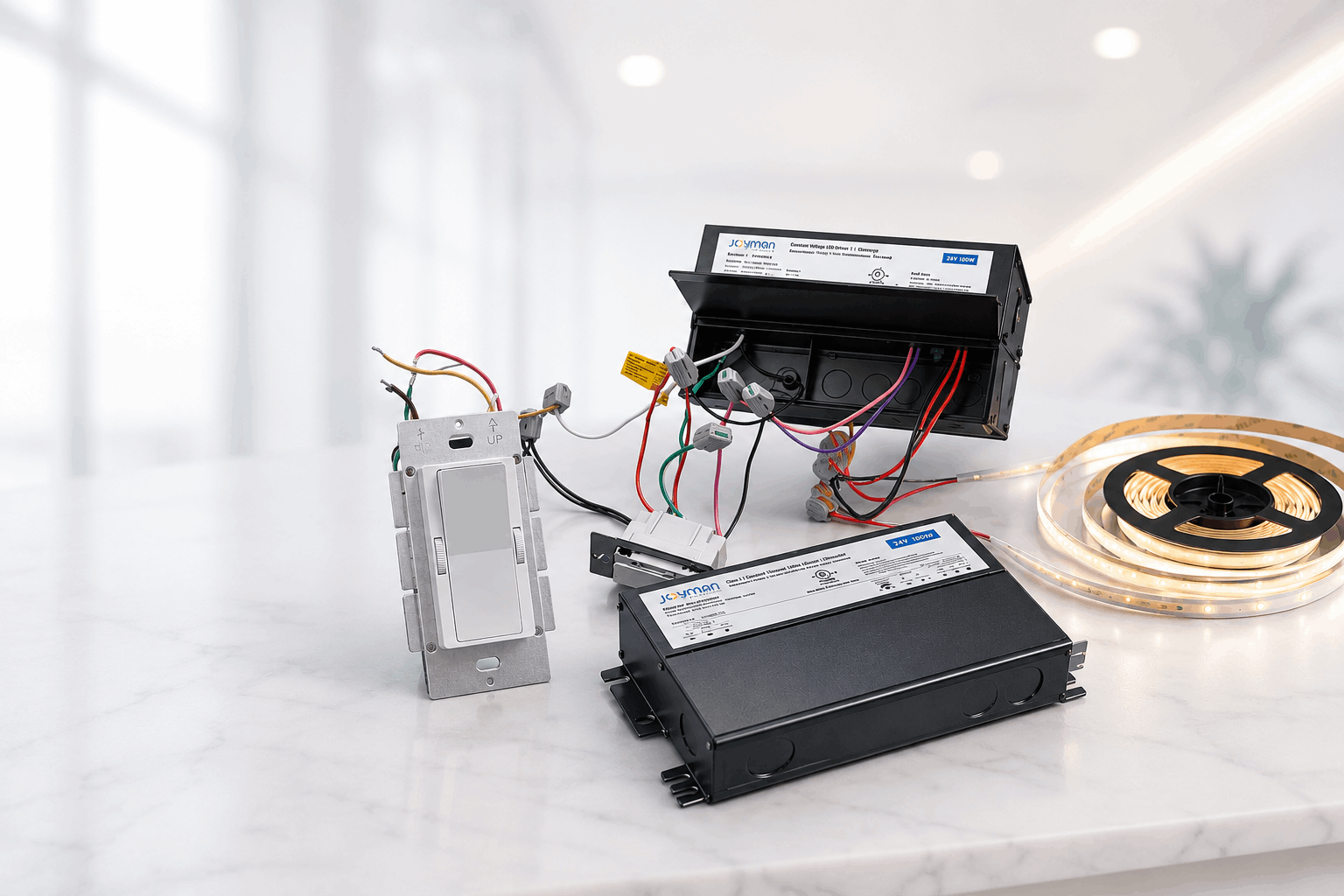
As LED lighting systems become more sophisticated, selecting the right dimmable driver is increasingly important. One term that frequently appears in specifications and product literature is 5-in-1 dimming. While many lighting professionals recognize the term, fewer understand how it can simplify projects, improve compatibility, and reduce inventory requirements.
This guide explains what 5-in-1 dimming is, how it works, and why it has become a preferred solution for many residential, commercial, and architectural lighting applications.
What Is 5-in-1 Dimming?
A 5-in-1 dimmable LED driver is designed to support multiple dimming methods within a single driver platform.
Instead of requiring different drivers for different control systems, a 5-in-1 driver can operate with several commonly used dimming technologies.
Typical dimming methods include:
Forward Phase (TRIAC)
Reverse Phase (ELV)
0-10V
1-10V
PWM (Pulse Width Modulation)
By supporting multiple dimming protocols, a single driver can be used across a wider range of projects and control systems.
Why Is Dimming Compatibility Important?
One of the most common challenges in LED lighting projects is compatibility between the dimmer and the driver.
When incompatible products are paired together, issues may occur such as:
Flickering
Limited dimming range
Audible noise
Inconsistent light output
Premature component failure
Customer complaints
Historically, contractors and distributors often needed to carefully match specific dimmers with specific drivers.
A 5-in-1 dimmable driver significantly reduces this concern by supporting multiple dimming methods from a single platform.
Understanding the Five Dimming Methods
Forward Phase (TRIAC)
Forward phase dimming, commonly known as TRIAC dimming, is one of the most widely used dimming technologies in North America.
It is frequently found in:
Residential applications
Retrofit projects
Existing wall dimmer installations
Advantages include:
Widely available controls
Familiar installation practices
Cost-effective implementation
Reverse Phase (ELV)
Electronic Low Voltage (ELV) dimming is often used in higher-performance lighting systems.
Compared to TRIAC dimming, ELV controls often provide:
Smoother dimming performance
Reduced audible noise
Better compatibility with modern LED loads
ELV dimming is common in premium residential and hospitality applications.
0-10V Dimming
0-10V dimming remains one of the most popular control methods in commercial lighting.
Applications include:
Offices
Schools
Healthcare facilities
Retail spaces
Commercial buildings
The system adjusts light output through a low-voltage control signal ranging from 0 to 10 volts.
Benefits include:
Reliable operation
Long control distances
Broad industry acceptance
1-10V Dimming
1-10V dimming operates similarly to 0-10V systems but maintains a minimum output level at the lowest control setting.
This method is commonly found in certain commercial and international lighting systems.
PWM Dimming
PWM (Pulse Width Modulation) dimming controls light output by rapidly switching power on and off at high frequency.
PWM dimming is commonly used in:
LED strip lighting
Specialty lighting systems
Architectural lighting controls
Color-changing lighting applications
PWM offers excellent dimming performance and precise light control.
Benefits of 5-in-1 Dimmable Drivers
Greater Project Flexibility
One driver can support multiple dimming methods, making it easier to adapt to varying project requirements.
Whether a project uses TRIAC dimmers in a residence or 0-10V controls in a commercial building, the same driver platform may be suitable.
Reduced Inventory Requirements
Distributors often stock separate drivers for different dimming systems.
A 5-in-1 driver helps reduce the number of SKUs required, simplifying inventory management and improving purchasing efficiency.
Simplified Product Selection
Contractors frequently encounter situations where dimming requirements change during a project.
A multi-dimming driver reduces the risk of ordering the wrong driver and minimizes compatibility concerns.
Improved Customer Satisfaction
By supporting multiple dimming technologies, lighting professionals can achieve smoother dimming performance and fewer field issues.
This often translates into fewer callbacks and happier end users.
Where Are 5-in-1 Drivers Commonly Used?
5-in-1 dimmable drivers are commonly used in:
Linear Lighting
Cove lighting
Recessed linear systems
Surface-mounted linear fixtures
Cabinet and Millwork Lighting
Under-cabinet lighting
Display shelving
Architectural millwork
Commercial Lighting
Offices
Hospitality spaces
Retail environments
Residential Applications
Kitchens
Living areas
Home theaters
Luxury residences
Display and Signage Lighting
Retail displays
Product showcases
Architectural accents
Additional Features to Consider
While dimming compatibility is important, lighting professionals should also evaluate additional driver features.
Universal Input Voltage
Drivers supporting 120-277VAC input provide greater flexibility across residential and commercial installations.
Integrated Junction Box
Drivers with integrated wiring compartments simplify installation and help create cleaner, code-compliant wiring connections.
Class 2 Design
Class 2 drivers can simplify installation and improve safety compliance in many low-voltage lighting applications.
UL Listing
UL Listed products provide confidence that the driver meets recognized safety standards for North American projects.
How Joyman Controls Approaches 5-in-1 Dimming
The Joyman Controls JLAC Series was developed to address the real-world challenges faced by distributors, contractors, OEM manufacturers, and lighting professionals.
Key features include:
5-in-1 dimming compatibility
Universal 120-277VAC input
12V, 24V, and 48V constant voltage options
Integrated junction box design
UL Listed construction
Class 2 models available
Multiple wattages for residential and commercial applications
By combining multiple dimming protocols within a single driver platform, the JLAC Series helps simplify product selection while providing reliable performance across a wide range of lighting applications.
Final Thoughts
As lighting projects become more diverse and control requirements continue to evolve, flexibility has become a key consideration when selecting LED drivers.
A 5-in-1 dimmable driver offers a practical solution by supporting multiple dimming technologies within a single platform. The result is greater compatibility, simplified inventory management, easier project planning, and improved installation flexibility.
For distributors, contractors, lighting designers, and OEM manufacturers, understanding 5-in-1 dimming can help reduce complexity and improve project outcomes.
When evaluating dimmable drivers for your next project, consider not only wattage and voltage requirements, but also how multi-dimming compatibility can simplify your lighting system and support future flexibility.