
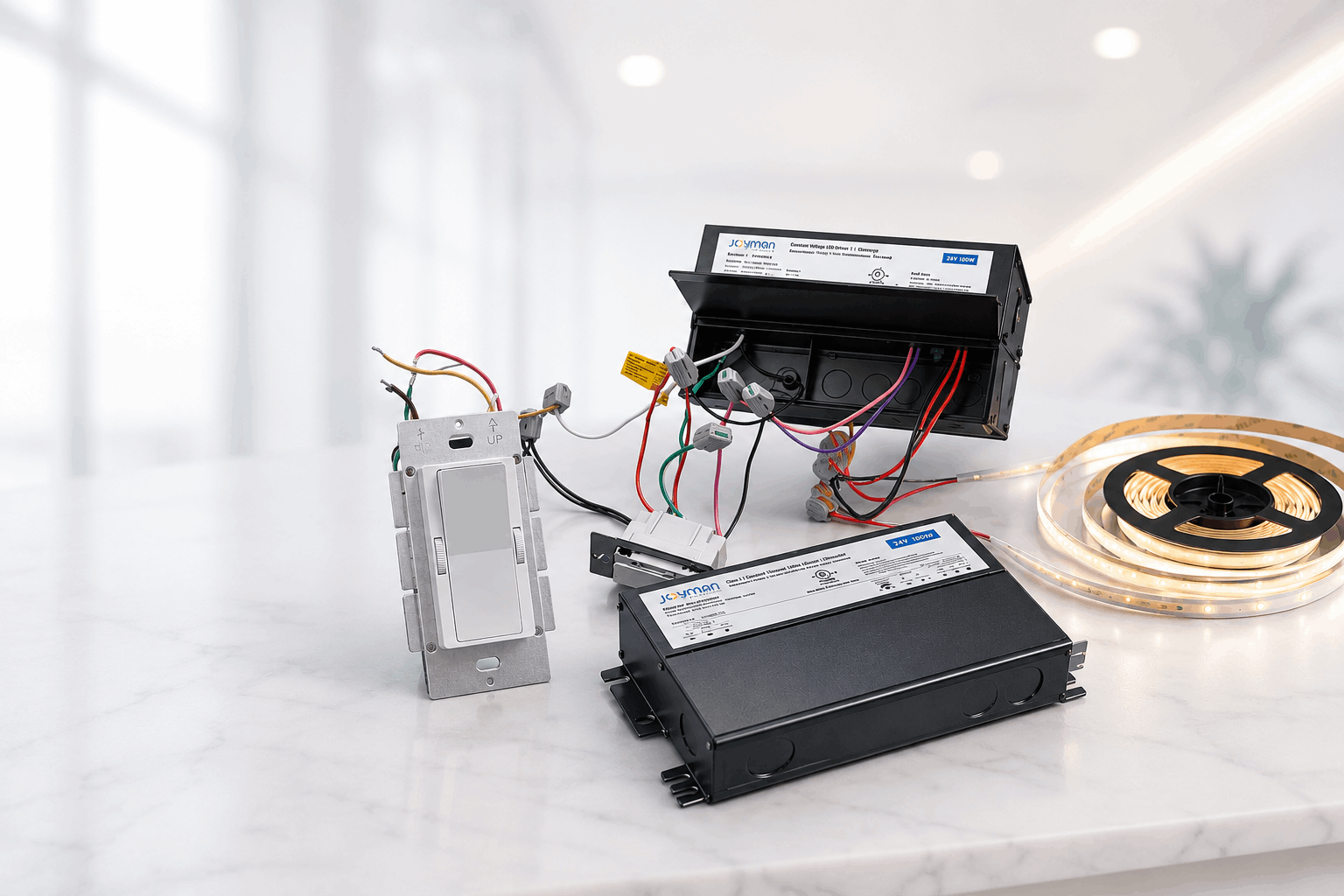
For OEM manufacturers, selecting the right lighting components is about much more than simply powering LEDs. The products chosen today will impact manufacturing efficiency, inventory management, product reliability, certification compliance, and long-term customer satisfaction.
Whether you manufacture architectural fixtures, display systems, illuminated millwork, signage, furniture, retail equipment, or specialty products with integrated lighting, understanding how to select the right LED drivers and controls is essential.
This guide outlines the key factors OEM manufacturers should consider when specifying lighting components for production applications.
Understanding OEM Lighting Requirements
Unlike project-based installations, OEM lighting applications often involve repeated manufacturing of the same product over months or years.
As a result, manufacturers typically prioritize:
Product consistency
Supply chain reliability
Certification compliance
Ease of assembly
Inventory simplification
Long-term availability
Cost optimization
A lighting component that works well for a single installation may not be the best choice for a production environment.
Start with the End Product
Before selecting a driver or control system, manufacturers should evaluate how lighting is integrated into the finished product.
Common OEM applications include:
Architectural Fixtures
Linear fixtures
Cove lighting systems
Decorative luminaires
Custom lighting assemblies
Cabinet and Millwork Products
Illuminated cabinetry
Display shelving
Hospitality millwork
Residential millwork systems
Retail and Display Equipment
Product displays
Merchandise showcases
Retail fixtures
Exhibition systems
Specialty Equipment
Medical equipment
Commercial equipment
Hospitality products
Industrial systems
Each application may have unique power, control, thermal, and installation requirements.
Constant Voltage vs. Constant Current
One of the first decisions is selecting the appropriate driver technology.
Constant Voltage Drivers
Most OEM lighting products using LED strips or flexible lighting systems rely on constant voltage drivers.
Typical outputs include:
12VDC
24VDC
48VDC
Common applications:
Linear lighting
Display lighting
Cabinet lighting
Accent lighting
Architectural systems
Constant Current Drivers
Constant current drivers are typically used when manufacturers design their own LED boards or fixtures.
Advantages include:
Precise LED control
Optimized fixture performance
Higher system efficiency
Flexible fixture design
For many fixture manufacturers, programmable constant current drivers offer additional flexibility by supporting multiple fixture configurations from a single driver platform.
Simplify Inventory Wherever Possible
Inventory complexity can become a major challenge for OEM manufacturers.
Using multiple driver models often creates:
Increased inventory investment
More purchasing requirements
Greater risk of shortages
Higher production complexity
Whenever possible, manufacturers should seek products that reduce SKU count.
Examples include:
Multi-Dimming Drivers
Drivers supporting:
TRIAC
ELV
0-10V
1-10V
PWM
allow one product platform to support multiple customer requirements.
Auto-Voltage Detection
Drivers capable of automatically recognizing 12V or 24V loads can reduce the number of products required for production.
Programmable Drivers
Programmable constant current drivers can often replace several fixed-output models.
The result is a more efficient manufacturing process and lower inventory costs.
Evaluate Installation and Assembly Efficiency
Every additional component increases assembly time.
When evaluating products, manufacturers should consider:
Wiring complexity
Number of connections
Mounting requirements
Assembly labor
Reducing assembly steps can significantly improve production efficiency.
Integrated Solutions
All-in-one driver solutions often combine:
Power supply
Dimming control
Voltage management
Benefits include:
Fewer components
Reduced wiring
Faster assembly
Simplified product design
These advantages can become significant in high-volume manufacturing environments.
Consider Product Size and Mechanical Constraints
Physical size is often one of the most important factors in OEM applications.
Lighting components must fit within the finished product without affecting appearance or functionality.
Ultra-Slim Drivers
Ideal for:
Furniture
Cabinetry
Display systems
Architectural millwork
Compact Junction Box Drivers
Useful when:
Internal wiring management is important
Field installation is required
Serviceability is a consideration
Waterproof Drivers
Suitable for:
Exterior products
Signage
Harsh environments
Damp locations
Selecting the appropriate enclosure style early in the design process can help avoid costly redesigns later.
Verify Certifications Early
Certification requirements should never be an afterthought.
Many OEM products require compliance with:
UL
cUL
FCC
RoHS
Using certified lighting components can simplify product approvals and reduce engineering risk.
Many customers also require certification documentation during product qualification and purchasing reviews.
Prioritize Long-Term Supply Stability
One of the biggest challenges OEM manufacturers face is product discontinuation.
A driver selected during product development may remain in production for many years.
Before specifying components, manufacturers should evaluate:
Supplier stability
Product roadmap
Availability commitments
Technical support capabilities
Reliable long-term supply is often more important than achieving the lowest initial cost.
Consider Future Product Expansion
A driver platform that supports multiple configurations provides greater flexibility as product lines evolve.
Examples include:
Multiple Wattage Options
A common product family offering:
60W
96W
192W
288W
384W
allows manufacturers to scale product offerings while maintaining design consistency.
Multiple Output Voltages
Supporting:
12V
24V
48V
can accommodate different product requirements without changing suppliers.
Multiple Dimming Protocols
Supporting various dimming methods increases compatibility with customer preferences and project specifications.
Common OEM Product Selection Mistakes
Manufacturers frequently encounter challenges when:
Selecting Based on Price Alone
The lowest-cost component may increase:
Warranty claims
Customer complaints
Production issues
Ignoring Installation Requirements
Drivers that are difficult to mount or wire can increase manufacturing costs.
Overlooking Future Availability
Product discontinuation can force costly redesigns.
Using Too Many Driver Models
Excessive SKU counts often create unnecessary inventory and purchasing complexity.
How Joyman Controls Supports OEM Manufacturers
At Joyman Controls, we work with OEM manufacturers, fixture builders, display fabricators, millwork companies, and lighting system integrators to provide reliable power and control solutions.
Our product portfolio includes:
JLAC Series Constant Voltage Drivers
Features include:
Universal 120-277VAC input
12V, 24V, and 48V outputs
5-in-1 dimming compatibility
Integrated junction box design
Multiple wattage options
Ultra-Slim Dimmable Drivers
Designed for space-constrained OEM applications.
Waterproof Aluminum Drivers
Suitable for demanding indoor and outdoor environments.
All-in-One Driver Solutions
Combining power and control functionality to simplify manufacturing and installation.
Programmable Constant Current Drivers
Supporting flexible fixture design and reduced inventory requirements.
Our goal is to help OEM customers simplify product development, improve manufacturing efficiency, and maintain long-term product reliability.
Final Thoughts
Successful OEM lighting products depend on more than just selecting a driver that powers LEDs. Manufacturers must consider assembly efficiency, inventory management, certification requirements, long-term availability, and future product expansion.
By choosing flexible, reliable, and production-friendly lighting components, OEM manufacturers can reduce engineering risk, improve manufacturing efficiency, and deliver better products to their customers.
Careful component selection early in the design process can help create a more scalable and successful lighting product for years to come.