
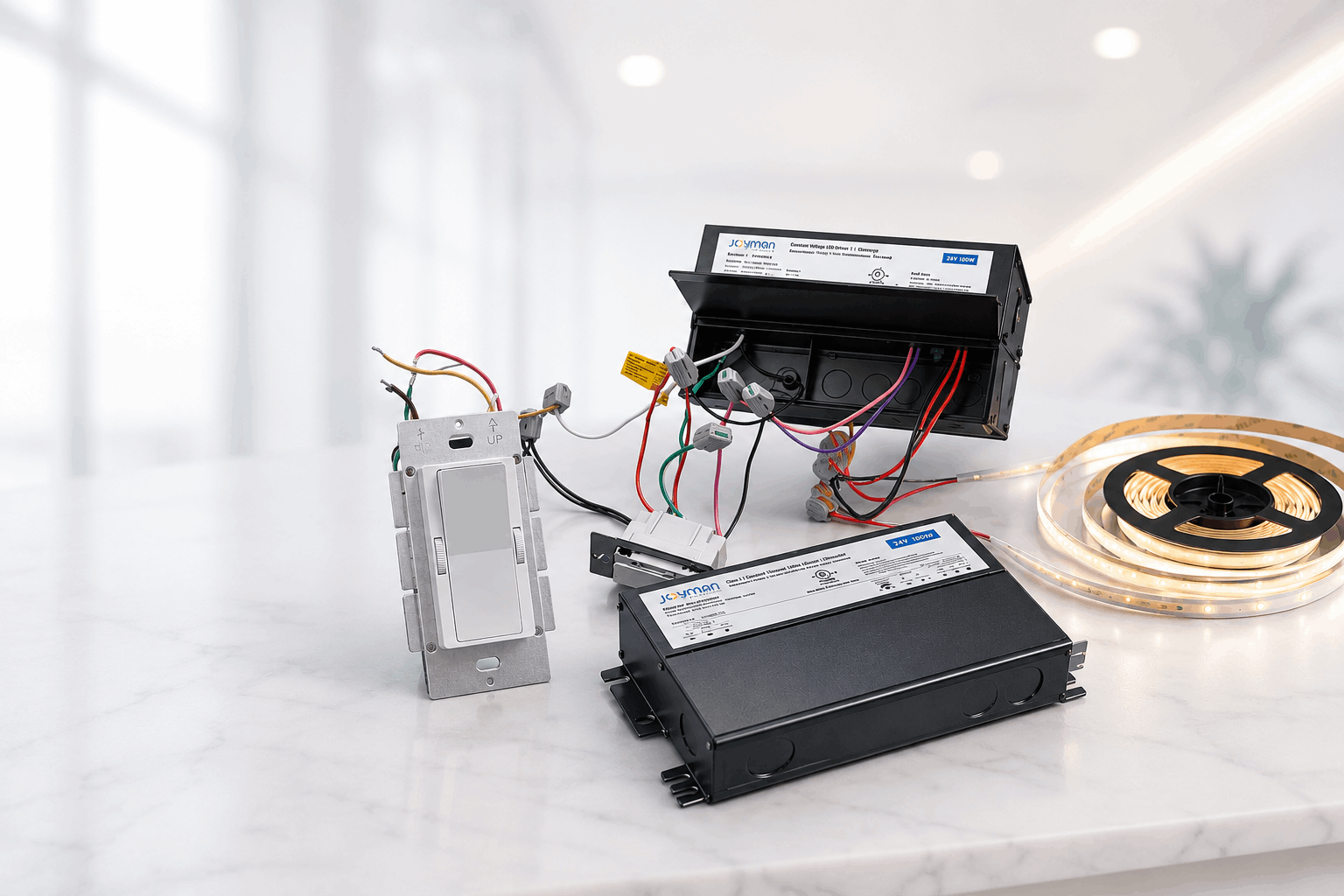
As LED lighting continues to evolve, selecting the right dimmable driver has become increasingly important for achieving reliable performance, smooth dimming, and long-term system compatibility. Whether you are designing a residential lighting project, specifying commercial linear lighting, building custom millwork, or integrating LED systems into manufactured products, the driver is one of the most critical components in the lighting system.
This guide outlines the key factors lighting professionals should consider when selecting an LED dimmable driver.
What Does an LED Driver Do?
An LED driver converts incoming AC power into the regulated DC power required by LED lighting systems. In addition to powering the LEDs, many drivers also provide dimming functionality, allowing users to adjust light levels while maintaining stable performance.
A properly selected driver helps ensure:
Smooth and consistent dimming
Longer LED lifespan
Improved energy efficiency
Reliable system operation
Compliance with electrical safety requirements
Choosing the wrong driver can result in flickering, compatibility issues, reduced performance, or even premature system failure.
Step 1: Determine Constant Voltage or Constant Current
The first step is identifying whether your lighting system requires a constant voltage or constant current driver.
Constant Voltage Drivers
Constant voltage drivers provide a fixed output voltage, typically:
12VDC
24VDC
48VDC
These drivers are commonly used for:
LED strip lighting
Linear lighting systems
Under-cabinet lighting
Cove lighting
Millwork and architectural lighting
Most LED strip and tape lighting applications use constant voltage drivers.
Constant Current Drivers
Constant current drivers regulate output current rather than voltage and are commonly used in:
Commercial luminaires
Architectural fixtures
OEM lighting products
Custom fixture manufacturing
Programmable constant current drivers can offer additional flexibility by allowing multiple output currents from a single driver platform.
Step 2: Verify Input and Output Requirements
Before selecting a driver, verify the electrical requirements of the lighting load.
Important considerations include:
Input Voltage
For North American projects, a universal input driver is often preferred.
Typical input range:
120-277VAC
This allows the same driver platform to be used across a wide variety of residential and commercial installations.
Output Voltage
Common constant voltage options include:
12VDC
24VDC
48VDC
Many modern LED systems are designed around 24VDC because it supports longer runs with reduced voltage drop.
Step 3: Choose the Right Dimming Method
One of the most common causes of lighting issues is dimming incompatibility.
Different projects may require different dimming technologies, including:
Forward Phase (TRIAC)
Common in residential applications and retrofit projects.
Reverse Phase (ELV)
Often used in higher-performance dimming systems.
0-10V
Widely used in commercial lighting applications.
PWM Dimming
Common in LED control systems and specialty applications.
1-10V
Used in certain commercial and international installations.
To maximize project flexibility, many lighting professionals prefer a 5-in-1 dimmable driver that supports multiple dimming protocols from a single platform.
Joyman Controls' JLAC Series drivers support multiple dimming methods, helping contractors and distributors reduce SKU complexity while improving compatibility across projects.
Step 4: Consider Installation Requirements
Installation environment plays a major role in driver selection.
Integrated Junction Box Drivers
For many residential and commercial projects, drivers with integrated junction boxes offer significant installation advantages.
Benefits include:
Simplified wiring
Reduced installation time
Cleaner installation
Fewer separate components
Improved wiring management
The Joyman Controls JLAC Series combines 5-in-1 dimming with an integrated wiring compartment, making installation easier for contractors and electricians.
Ultra-Slim Drivers
Applications such as cabinetry, millwork, furniture, and display fixtures often have limited space.
Ultra-slim drivers can be concealed within tight spaces while still providing reliable dimming performance.
Waterproof Drivers
Outdoor and damp-location applications may require waterproof driver solutions housed in sealed aluminum enclosures.
Common applications include:
Landscape lighting
Signage
Exterior architectural lighting
Facade illumination
Step 5: Select the Appropriate Wattage
Driver capacity should always exceed the connected LED load.
A common industry recommendation is to size the driver at approximately 80% of its rated capacity.
For example:
LED Load: 80W
Recommended Driver: 96W or 100W minimum
This helps improve reliability and extends operating life.
Common wattage options include:
60W
96W
192W
288W
384W
Selecting the proper wattage helps ensure stable performance and allows room for future expansion.
Step 6: Verify Certifications and Compliance
For North American projects, certification is often required by inspectors, contractors, and specification teams.
Look for drivers that offer:
UL Listed or cUL Listed certification
FCC compliance
RoHS compliance
Class 2 ratings where applicable
Certified products help simplify project approvals and provide confidence in long-term reliability.
Step 7: Evaluate Long-Term Reliability
The lowest-cost driver is not always the lowest-cost solution.
When evaluating drivers, consider:
Warranty period
Dimming performance
Thermal management
Component quality
Manufacturer support
Technical documentation availability
A driver that performs reliably over many years can significantly reduce maintenance and replacement costs.
Choosing the Right Driver for Your Application
While every project is different, the following general guidelines can help:
Residential Lighting
Recommended:
TRIAC / ELV dimmable drivers
Compact junction-box designs
12V or 24V constant voltage outputs
Commercial Linear Lighting
Recommended:
5-in-1 dimmable drivers
Universal 120-277VAC input
High-wattage options
Cabinet and Millwork Lighting
Recommended:
Ultra-slim dimmable drivers
Compact installation footprint
24V constant voltage systems
Outdoor and Signage Applications
Recommended:
Waterproof aluminum drivers
High-efficiency operation
Outdoor-rated construction
OEM and Fixture Manufacturing
Recommended:
Programmable constant current drivers
Flexible output current selection
Reduced SKU requirements
Final Thoughts
The right LED dimmable driver can have a significant impact on system performance, installation efficiency, and long-term reliability. By evaluating voltage requirements, dimming compatibility, installation constraints, certifications, and application needs, lighting professionals can select solutions that deliver dependable results.
At Joyman Controls, we offer a range of LED dimmable driver solutions, including integrated junction-box drivers, ultra-slim drivers, waterproof drivers, and programmable constant current drivers designed for commercial, architectural, OEM, and linear lighting applications.
Whether you are powering a residential lighting project or a large-scale commercial installation, choosing the right driver is the first step toward a successful lighting system.