
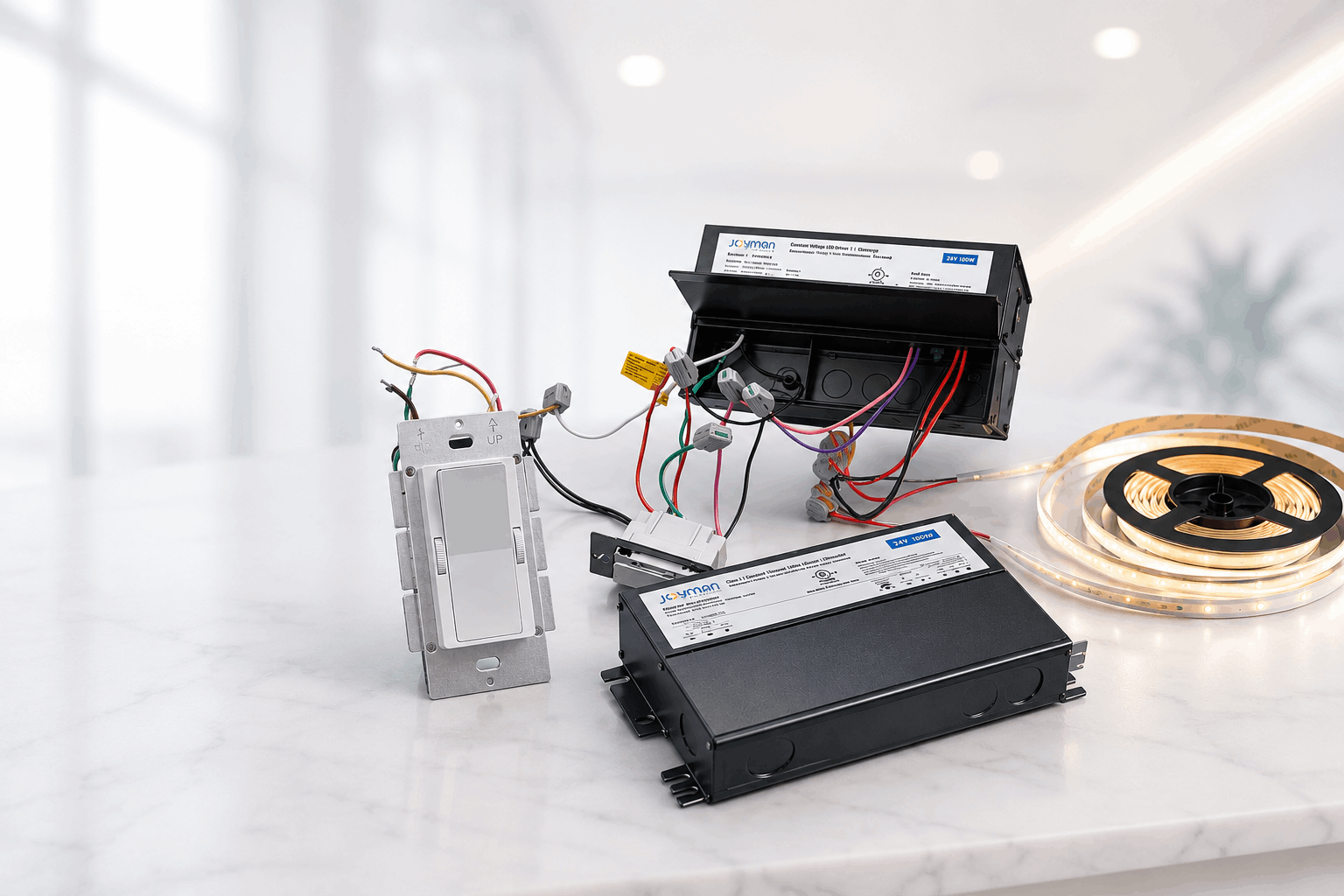
When designing an LED lighting system, one of the first decisions lighting professionals must make is whether to use an all-in-one driver solution or build the system using separate components.
Traditionally, many low-voltage lighting systems consisted of multiple devices, including an LED driver, wall dimmer, control interface, and additional wiring components. However, advances in LED driver technology have led to the development of all-in-one driver solutions that integrate power and control into a single compact unit.
Both approaches can be effective, but understanding the advantages and limitations of each can help contractors, distributors, OEM manufacturers, and lighting designers select the best solution for their projects.
Understanding the Two Approaches
All-in-One Driver Solutions
An all-in-one driver combines multiple functions into a single device.
Depending on the design, an all-in-one driver may integrate:
LED power supply
Dimming control
Voltage selection
Wireless control functions
Junction box or wiring compartment
The goal is to simplify installation while reducing the number of components required in the lighting system.
Separate Component Systems
Traditional systems use individual devices for each function.
A typical installation may include:
LED driver
Wall dimmer
Control interface
Junction box
Additional low-voltage wiring
This approach offers maximum flexibility but often increases installation complexity.
Comparing Installation Complexity
All-in-One Drivers
One of the biggest advantages of integrated drivers is installation simplicity.
Because power and control functions are housed within a single unit, installers benefit from:
Fewer components
Reduced wiring
Faster installation
Less troubleshooting
Cleaner system layouts
For contractors managing multiple projects, reducing installation time can significantly lower labor costs.
Separate Components
Traditional systems require multiple devices to be installed and connected correctly.
This often means:
Additional wiring runs
More junction points
More installation time
Increased risk of wiring errors
For simple lighting systems, the additional complexity may not provide significant advantages.
Dimming Compatibility Considerations
One of the most common challenges in LED lighting projects is ensuring compatibility between the dimmer and the driver.
Separate Component Systems
With separate components, compatibility must be verified between:
Driver
Dimmer
Control system
LED load
If any component is incompatible, issues such as flickering, limited dimming range, or performance problems may occur.
All-in-One Drivers
Integrated solutions are designed to eliminate much of this uncertainty.
Because the driver and control system are engineered together, users benefit from:
Consistent performance
Simplified product selection
Reduced compatibility concerns
Smoother dimming operation
For many contractors and distributors, this is one of the most valuable benefits of an integrated design.
Inventory Management Benefits
Separate Components
Distributors often need to stock:
Multiple driver models
Various dimmers
Different control interfaces
Additional accessories
This can increase inventory complexity and purchasing costs.
All-in-One Drivers
Integrated products can reduce the number of SKUs required to support common applications.
This helps:
Simplify inventory management
Reduce warehouse space requirements
Improve purchasing efficiency
Minimize ordering mistakes
For distributors and OEMs, fewer SKUs often translate into lower operating costs.
Space Constraints and Installation Flexibility
Modern lighting projects frequently involve tight installation spaces.
Examples include:
Cabinet lighting
Millwork
Furniture integration
Display fixtures
Architectural details
All-in-One Drivers
Compact integrated designs can be easier to conceal and install in restricted spaces.
Because fewer devices are required, installation becomes more straightforward.
Separate Components
Multiple components often require additional mounting locations and wiring pathways.
In space-constrained applications, this may complicate installation.
Project Cost Considerations
When evaluating cost, it is important to consider more than just the price of the hardware.
Hardware Cost
Separate components may sometimes appear less expensive when comparing individual device pricing.
However, hardware cost is only one part of the equation.
Installation Cost
Labor frequently represents a significant portion of project expenses.
Integrated solutions often reduce:
Installation time
Wiring requirements
Troubleshooting
Commissioning effort
In many cases, total installed cost may be lower despite a slightly higher product price.
When Separate Components Make Sense
Separate components are often preferred when:
Advanced Building Controls Are Required
Large commercial buildings may utilize:
DALI systems
Building automation systems
Centralized lighting controls
Networked control platforms
These projects often require dedicated control hardware.
Highly Customized Systems
Certain specialty applications may require:
Unique control interfaces
Multiple control zones
Specialized automation requirements
Separate components provide maximum flexibility for complex installations.
When All-in-One Drivers Make Sense
Integrated driver solutions are often the preferred choice for:
Residential Lighting
Under-cabinet lighting
Cove lighting
Accent lighting
Living spaces
Hospitality Projects
Hotels
Restaurants
Lounge areas
Retail and Display Lighting
Product displays
Showcase lighting
Merchandising systems
Millwork and Cabinetry
Custom cabinetry
Furniture integration
Architectural woodwork
OEM Applications
Manufactured products
Lighting-integrated equipment
Specialty systems
In these applications, simplicity, reliability, and reduced installation time are often more valuable than advanced control customization.
The Role of Auto-Voltage Detection
One of the latest advancements in integrated driver technology is automatic voltage detection.
Certain all-in-one driver solutions can automatically recognize whether the connected load requires:
12VDC
24VDC
This provides several benefits:
Reduced inventory requirements
Simplified product selection
Lower risk of installation errors
Greater project flexibility
A single product can often support multiple application requirements.
How Joyman Controls Approaches Integrated Driver Design
At Joyman Controls, our all-in-one driver solutions are designed to simplify LED lighting projects while delivering reliable performance.
Key features include:
Integrated dimmer and driver functionality
Automatic 12V/24V output detection
Compact installation-friendly design
Smooth flicker-free dimming
Reduced wiring requirements
Simplified product selection
UL Listed construction
By combining power and control into a single device, these solutions help contractors, distributors, and OEM manufacturers reduce complexity while improving installation efficiency.
Final Thoughts
There is no single solution that fits every lighting project.
Separate component systems continue to offer flexibility for large-scale commercial and highly customized installations. However, for many residential, hospitality, retail, millwork, and OEM applications, integrated all-in-one drivers provide compelling advantages.
By reducing wiring, simplifying installation, minimizing compatibility concerns, and lowering inventory complexity, all-in-one driver solutions can help lighting professionals deliver projects more efficiently and cost-effectively.
As LED lighting systems continue to evolve, integrated driver technologies are becoming an increasingly attractive option for projects where simplicity, reliability, and performance are key priorities.