
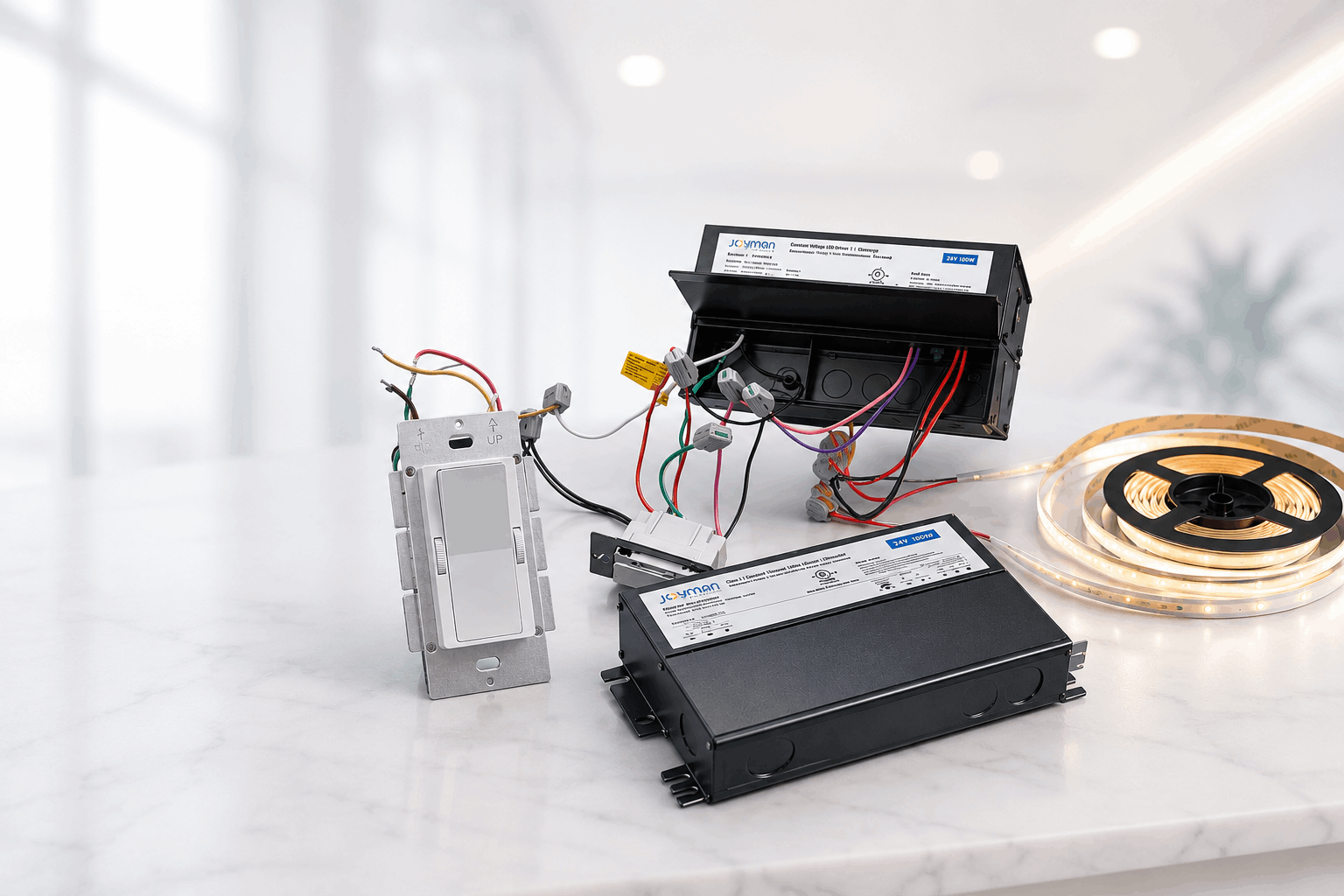
LED lighting systems have become the preferred solution for residential, commercial, architectural, and specialty lighting applications. However, one of the most commonly misunderstood components in these systems is the LED driver.
Among the various driver technologies available, constant voltage drivers are the most widely used for LED strip lighting, linear lighting, cabinet lighting, and architectural illumination.
This guide explains how constant voltage LED drivers work, where they are used, and how to select the right driver for your project.
What Is a Constant Voltage LED Driver?
A constant voltage LED driver is a power supply that converts incoming AC power into a fixed DC output voltage.
Common output voltages include:
12VDC
24VDC
48VDC
Unlike constant current drivers, which regulate output current, constant voltage drivers maintain a stable voltage while allowing connected LED loads to draw the current they require.
This makes them ideal for many low-voltage LED lighting systems.
Why Are Constant Voltage Drivers So Popular?
Constant voltage technology has become the industry standard for many lighting applications because it offers:
Simple installation
Flexible system design
Easy fixture expansion
Broad compatibility
Cost-effective implementation
Most LED strips, tape lights, and low-voltage linear lighting systems are specifically designed to operate from a constant voltage power source.
How Does a Constant Voltage Driver Work?
A constant voltage driver takes incoming AC power, such as:
120VAC
277VAC
and converts it into a stable DC output.
For example:
Input:120-277VAC
Output:24VDC
As long as the connected LED load remains within the driver's rated capacity, the output voltage remains constant.
This ensures consistent LED performance and reliable operation.
Constant Voltage vs. Constant Current
One of the most common questions in lighting design is:
"Do I need a constant voltage driver or a constant current driver?"
Constant Voltage Drivers
Provide:
Fixed output voltage
Variable current draw
Typically 12V, 24V, or 48V
Common applications:
LED strip lighting
Cove lighting
Cabinet lighting
Linear lighting
Signage
Display lighting
Constant Current Drivers
Provide:
Fixed output current
Variable output voltage
Common applications:
Commercial luminaires
Downlights
Architectural fixtures
OEM fixture manufacturing
As a general rule:
If you are powering LED strips or tape lighting, you likely need a constant voltage driver.
If you are powering a finished LED fixture with a specified operating current, you likely need a constant current driver.
Why 24V Systems Are Increasingly Popular
While both 12V and 24V systems remain common, many lighting professionals now prefer 24V systems.
Advantages include:
Reduced Voltage Drop
Longer runs can be achieved without noticeable brightness reduction.
Smaller Current Requirements
For the same power level, 24V systems require less current than 12V systems.
Improved Efficiency
Lower current means reduced conductor losses.
Better for Large Installations
Commercial and architectural projects often benefit from longer lighting runs and improved performance.
This is why many modern linear lighting systems are built around 24VDC architecture.
Common Constant Voltage Applications
Cabinet and Millwork Lighting
Constant voltage drivers are widely used for:
Under-cabinet lighting
Shelf lighting
Display niches
Architectural millwork
Residential Lighting
Applications include:
Cove lighting
Accent lighting
Kitchen lighting
Living room illumination
Commercial Linear Lighting
Common uses:
Office lighting
Hospitality projects
Retail lighting
Architectural linear systems
Display and Signage
Constant voltage drivers are frequently used for:
Retail displays
Illuminated shelving
Signage systems
Showcase lighting
Understanding Driver Wattage
Selecting the correct wattage is essential for long-term reliability.
The driver's wattage rating must exceed the connected LED load.
For example:
LED Load:80W
Recommended Driver:96W or higher
Many lighting professionals follow the 80% loading guideline, which provides additional operating margin and improves reliability.
Typical driver sizes include:
60W
96W
192W
288W
384W
Dimming Options for Constant Voltage Drivers
Modern constant voltage drivers often include dimming capabilities.
Common dimming methods include:
TRIAC Dimming
Often used in residential applications.
ELV Dimming
Provides smooth dimming performance for many premium installations.
0-10V Dimming
Widely used in commercial lighting projects.
PWM Dimming
Common in LED strip and architectural lighting systems.
5-in-1 Dimming
Some advanced drivers support multiple dimming methods in a single platform.
Benefits include:
Greater compatibility
Reduced inventory requirements
Simplified project planning
Fewer installation issues
Installation Considerations
Not all constant voltage drivers are designed for the same installation environment.
Junction Box Drivers
These drivers include an integrated wiring compartment.
Advantages include:
Simplified installation
Cleaner wiring
Reduced labor time
Improved serviceability
Ultra-Slim Drivers
Ideal for:
Cabinetry
Furniture integration
Millwork
Tight spaces
Waterproof Drivers
Suitable for:
Outdoor lighting
Landscape lighting
Signage
Damp locations
The appropriate driver style depends on the project environment and installation requirements.
Certifications Matter
For North American projects, certified drivers provide additional confidence and compliance.
Look for products offering:
UL Listing
cUL Listing
FCC Compliance
RoHS Compliance
Class 2 Ratings where applicable
Certified products can simplify project approvals and provide assurance of product quality.
How Joyman Controls Approaches Constant Voltage Drivers
Joyman Controls offers several constant voltage driver platforms designed for residential, commercial, architectural, and OEM applications.
Our solutions include:
JLAC Series Drivers
Features include:
120-277VAC universal input
12V, 24V, and 48V outputs
5-in-1 dimming compatibility
Integrated junction box design
UL Listed construction
Multiple wattage options
Ultra-Slim Dimmable Drivers
Designed for applications with limited installation space.
Waterproof Aluminum Drivers
Engineered for indoor and outdoor lighting environments.
All-in-One Driver Solutions
Integrated power and control functionality designed to simplify installation and reduce component count.
These product families provide flexibility across a wide range of lighting applications while maintaining consistent performance and reliability.
Final Thoughts
Constant voltage LED drivers are the foundation of many modern LED lighting systems. From residential cove lighting to commercial linear lighting and architectural installations, they provide a simple and reliable method for powering low-voltage LED loads.
Understanding output voltage, wattage requirements, dimming compatibility, and installation constraints can help ensure successful project outcomes.
Whether you are designing a residential lighting system, specifying commercial linear fixtures, or integrating LED technology into manufactured products, selecting the right constant voltage driver is one of the most important decisions in the lighting design process.